

Invictus Cockpit Systems
AIM Phoenix
AIM Phoenix
Couldn't load pickup availability
Low stock: 4 left
AIM Phoenix
The I²C hub for instrument-heavy sections.
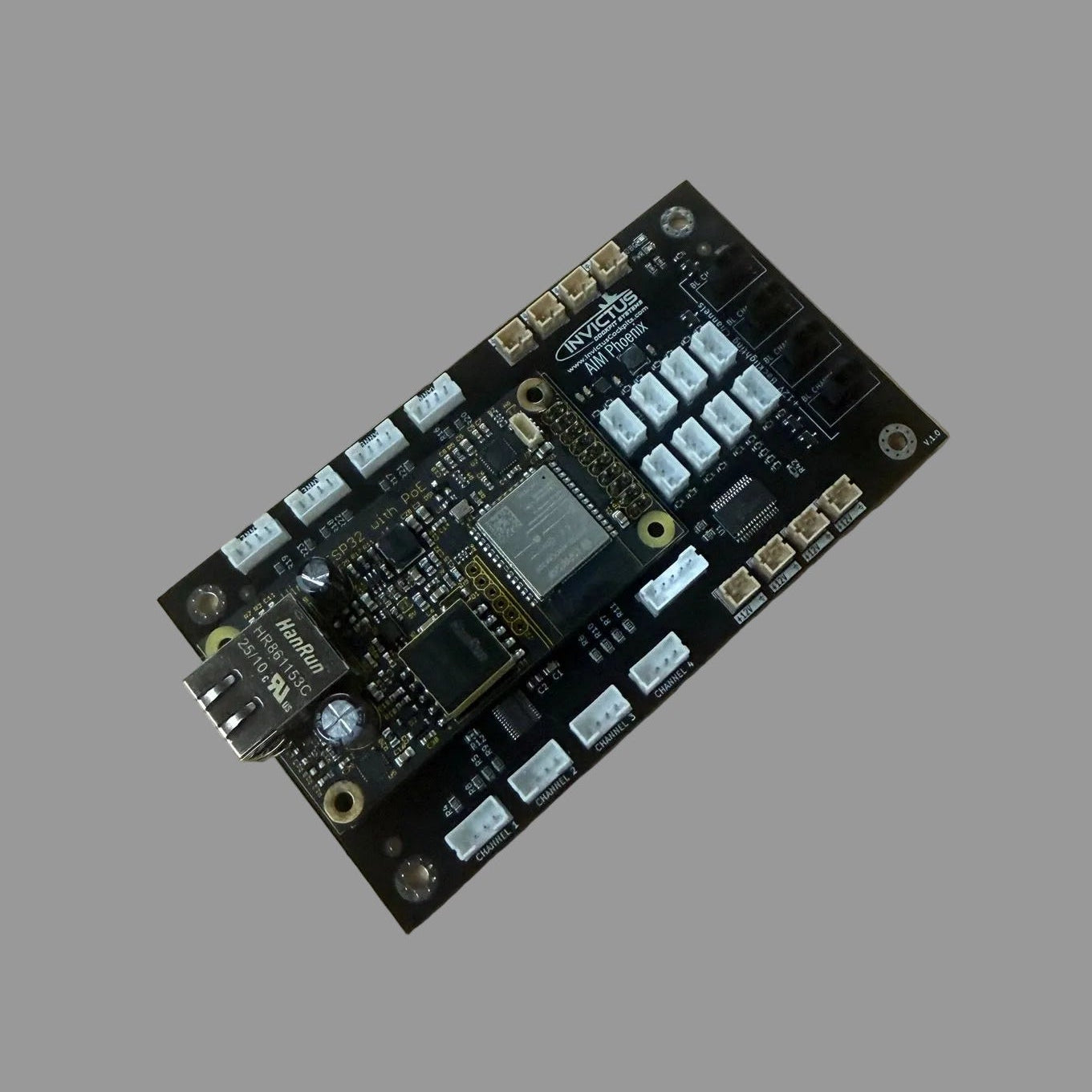
Phoenix is the AIM Network board for the part of the cockpit that lives in front of you: gauges, MFDs, segmented displays, caution panels, and any other instrument that speaks I²C. It hands you eight independent I²C channels, each on its own connector, with a dedicated bus for each instrument. Wire your instruments to their own channels and they never have to fight over a shared bus.
Like every AIM board, Phoenix runs on a single Ethernet cable. The same cable carries the data and the power, so the only thing your instrument panel needs from you is one Cat 5e drop back to the PoE switch.
Who Phoenix is for
If the section you are working on is mostly switches and knobs, the Sidewinder is the board you want. If you're work of the day is mostly instruments, segmented displays, and gauges, Phoenix is the one. A typical heavy-instrument zone like a Main Instrument Panel gets a single Phoenix to drive every display, plus a Sidewinder nearby for whatever switches and knobs share the area.
What you can plug in
- 8 I²C peripheral channels, each on its own 4-pin JST PH header. Channels are electrically independent through an on-board mux, so two instruments with the same I²C address can run side by side without conflicts.
- 16 digital inputs for the few buttons and switches that live alongside the instruments. Wire a contact to ground and Phoenix reads it.
- PoE in. Plug into a PoE switch and Phoenix powers up. No DC bus to plan.
- Ethernet management LEDs built into the network jack for link and activity at a glance.
Designed for cable runs in the cockpit
Cockpits are not breadboards. Cables run two meters across the panel, get jostled, get touched, and sometimes get static-zapped. Phoenix is designed around that:
- Each I²C channel runs at the standard 100 kHz with 2.2 kΩ pullups, giving you healthy timing margin across a typical 1.5 to 2 m cable to the instrument.
- ESD protection on every external connector pin, rated to the same ±15 kV contact discharge spec the rest of the AIM line uses.
- 1500 Vrms isolation between the Ethernet path and the cockpit-side circuitry, so a PoE injector glitch stays on its own side of the board.
If you need to reach an instrument further than 2 m away, add a small I²C bus extender at the instrument end.
Pairs with the rest of the AIM Network
Phoenix is the same network citizen as every other AIM board. The Cockpit Manager software running on your sim PC discovers it on first power-up and walks you through the same setup wizard: name the board, pick which panels it owns, assign the wired inputs. Save and you are done.
Firmware updates land over the network. You will not have to crawl inside your sim or take it apart to plug in a USB cable to update your instruments.
Setup in plain English
- Plug Ethernet into a PoE switch. Phoenix powers up and announces itself.
- The AIM Cockpit Manager spots it on the network. You name the board and pick the instruments it drives.
- Wire each instrument to its own I²C channel. The Manager handles addressing and routing for you.
Specs at a glance
| I²C peripheral channels | 8 independent, 4-pin JST PH headers |
| I²C speed | 100 kHz standard mode, 2.2 kΩ pullups per channel |
| Max cable run | 1.5 to 2 m per channel without extenders |
| Digital inputs | 16 contact-closure channels |
| Power | Power over Ethernet (IEEE 802.3af/at), 12.95 W max |
| Network | 10/100 Ethernet, auto-MDIX |
| Operating temperature | 0 to 50 °C |
| Works with | AIM Cockpit Manager software (Windows) |
What's in the box
- One AIM Phoenix instrument hub
Shipping & Returns
Shipping & Returns
Welcome to Invictus Cockpit Systems, where every product is meticulously handcrafted with the perfect fusion of human skill and advanced machinery in our Mesa, AZ shop. While our goal is to have all items readily available for immediate shipping, some products might take up to two weeks to ship as we expand our inventory. For your convenience, any product with a shipping time that exceeds two weeks will be clearly marked. We take immense pride in our quality and offer a hassle-free return policy. If you're unsatisfied for any reason, returns are accepted at any time. Contact our Customer Support for assistance, and we'll ensure your experience with us is exceptional from start to finish.
Reviews
No reviews yet. Own one of these? Be the first to leave one below.