Invictus Cockpit Systems
AIM Sidewinder
AIM Sidewinder
Verfügbarkeit für Abholungen konnte nicht geladen werden
Nicht vorrätig
AIM Sidewinder
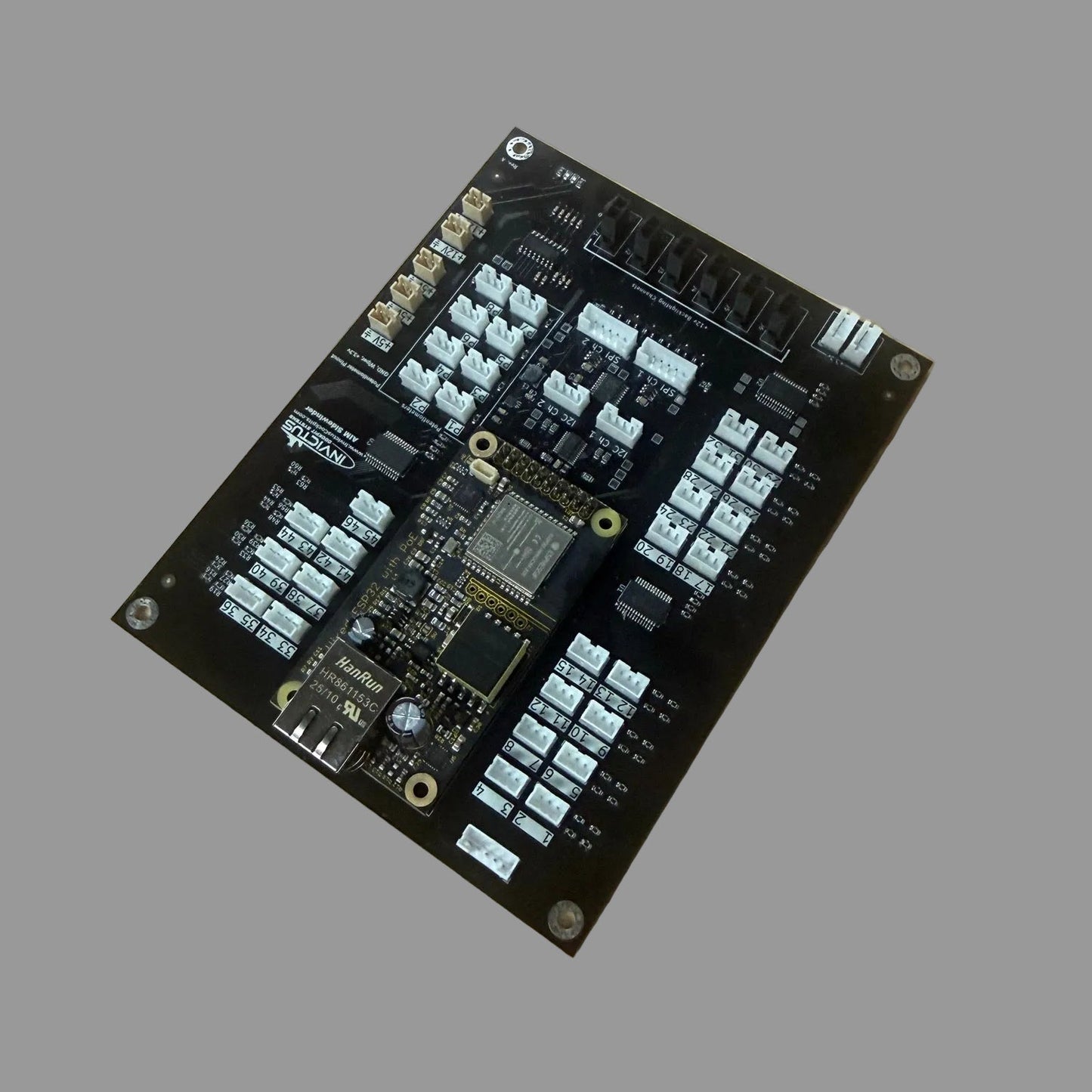
The Sidewinder is the board that connects your cockpit switches, knobs, indicators, and panel backlighting to your flight simulator. Run a single Ethernet cable to it and you are done. The same cable carries the data and the power, so you can skip the wall warts and the 12 V bus you would otherwise be stringing through the airframe.
Most cockpits use four or five Sidewinders to drive the entire cockpit. You can lessen the number of boards needed by carefully budgeting GPIO pins and avoiding connecting unused switches, indicators, etc.
What it does for you
- Reads your panel. Every switch flip, knob turn, and slider movement gets to the sim through one Ethernet drop.
- Drives your panel. Indicator lights, segment displays, caution panels, and backlighting all run from the same board.
- Powered over Ethernet. Plug into a standard PoE switch. No DC harness. No wall warts. No 12 V brick.
- Configured in software. The AIM Cockpit Manager handles naming, wiring, and firmware updates. No USB cable needed.
What you can plug in
- 46 switch inputs for toggles, pushbuttons, rotaries, and encoders. Wire a switch to ground and the Sidewinder reads it.
- 8 analog inputs for potentiometers, sliders, and any other 0 to 3.3 V signal. 12-bit resolution.
- 2 SPI peripheral headers for cockpit display panels, segment displays, caution panels, and similar SPI-driven instruments.
- 2 I²C peripheral headers for I²C-controlled panels and AIM accessory boards like the Sparrow relay daughter.
- 6 backlight channels for panel lighting, dimmed together by the master cockpit brightness control.
- 3 aux analog inputs broken out separately for future sensors and expansion.
Built for the cockpit
Stuff happens. A wire shorts to ground, a static shock hits a switch, a stray drop of solder bridges two pins. Every input and every panel connector has ESD protection and current limiting built in. The Sidewinder shrugs it off and keeps running.
The Ethernet path is fully isolated from the cockpit-side electronics (1500 Vrms), so PoE injector hiccups stay on their own side of the board.
Setup in plain English
- Plug Ethernet into a PoE switch. The Sidewinder powers up and announces itself.
- The AIM Cockpit Manager spots it on the network and walks you through naming the board and picking the panels it owns.
- Map your wired switches, knobs, and indicators to sim functions. Save. Done.
Firmware updates land over the network too. You will never need to crawl under the panel to plug in a USB cable.
Specs at a glance
| Inputs | 46 digital, 8 analog, 3 aux analog |
| Outputs | 6 backlight zones, 2 SPI ports, 2 I²C ports |
| Power | Power over Ethernet (IEEE 802.3af/at), 12.95 W max |
| Typical draw | About 3 W in normal operation |
| Network | 10/100 Ethernet, auto-MDIX |
| Operating temperature | 0 to 50 °C |
| Connectors | 2 mm pitch JST headers throughout |
| Works with | AIM Cockpit Manager software (Windows) |
What's in the box
- One AIM Sidewinder controller board
Shipping & Returns
Shipping & Returns
Welcome to Invictus Cockpit Systems, where every product is meticulously handcrafted with the perfect fusion of human skill and advanced machinery in our Mesa, AZ shop. While our goal is to have all items readily available for immediate shipping, some products might take up to two weeks to ship as we expand our inventory. For your convenience, any product with a shipping time that exceeds two weeks will be clearly marked. We take immense pride in our quality and offer a hassle-free return policy. If you're unsatisfied for any reason, returns are accepted at any time. Contact our Customer Support for assistance, and we'll ensure your experience with us is exceptional from start to finish.